What is GAND?
GAND stands for
GATAD2B -associated neurodevelopmental disorder. The
GATAD2B
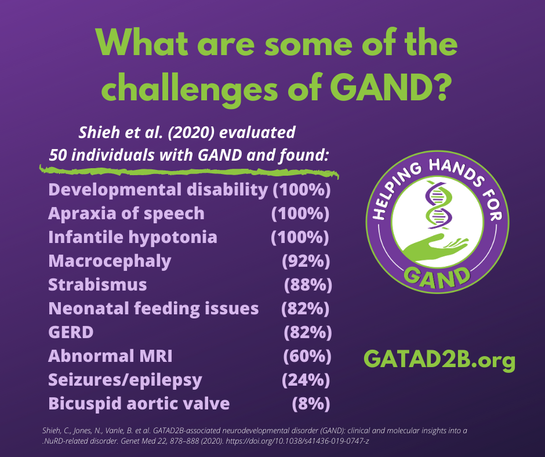
gene is located on chromosome 1 (at 1q21.3) and is an important gene for normal cognitive development. Most patients so far identified have had intellectual disability, low muscle tone, apraxia of speech, strabismus, macrocephaly, and distinct physical characteristics, including a high wide forehead/frontal bossing, tubular-shaped nose with broad nasal tip, and short philtrum. Many of these children have experienced feeding difficulties, particularly in infancy.
Nearly all cases of this disorder occur through a
de novo
(i.e., new) mutation in the
GATAD2B
gene and are, in these cases, not inherited from either parent. However, affected siblings are possible and have been noted in identical twins and in rare cases when one of the parents has low-level mosaicism, meaning that a small percentage of the cells within that person have a different genetic makeup. Children of individuals with GAND would have a 50% chance of sharing the disorder.
If you know a patient with a
GATAD2B
variant, please
contact us.
Research Articles
To date, Helping Hands for GAND has awarded $150,000 in research grants to support work aimed at expanding the existing knowledge of GAND. The following papers represent research that HHFG has directly supported:
The NuRD complex and macrocephaly associated neurodevelopmental disorders
(Pierson et al., November 2019)
GATAD2B-associated neurodevelopmental disorder (GAND): clinical and molecular insights
into a NuRD-related disorder
(Shieh et al., January 2020)
Gatad2b,
associated with the neurodevelopmental syndrome GAND, plays a critical role
in neurodevelopment and cortical patterning
(Abad et al., January 2024)
We look forward to sharing more published works in the future as current projects continue to yield new insights into this rare disorder.
Videos
Graphics